

The easy growth story is starting to break into harder questions.
ElevenLabs just doubled its valuation to $22B. OpenAI launched a new wave of agents. Google pushed Gemini deeper into autonomous cyber work. But the economics underneath all of this are getting harder to ignore, from weak consumer monetization to Anthropic’s heavy dependence on Amazon and Google.
Meanwhile, venture funds are becoming more specialized in how they source and support founders, whether through infrastructure expertise, university networks, or tightly focused enterprise AI strategies.
Five signals worth watching today:
ElevenLabs doubled its valuation to $22B.
Google launched Gemini 4 Argon for autonomous cybersecurity work.
OpenAI introduced Dots, its new always-on enterprise agents.
Consumer AI usage is rising, but monetization remains difficult.
More than $217M closed across new infrastructure, student-founder, and enterprise AI funds.
FROM OUR PARTNER - SEMRUSH ONE
Your customers are searching on Google AND ChatGPT. Can they find you on both?
Search has changed. Ranking on Google still matters, but buyers are also asking AI tools which products to use, which companies to trust, and how different options compare.

Semrush One brings both sides into one place. You can track your Google rankings and AI mentions, see the prompts driving demand, compare your visibility against competitors, and find gaps you can actually act on.
It monitors 239M+ relevant LLM prompts globally, alongside the SEO data Semrush is already known for.
PARTNERSHIP WITH US
🤝 Get your brand in front of 125,000+ decision makers.
Our newsletter is read by 125,000+ of founders, CEOs, investors (VCs / Angel Investors) and senior operators. Get in touch today.
STARTUPS RAISING MILLIONS
💰 Startup Funding Updates
At least $824M + €66.7M disclosed across today’s startup rounds
The three biggest rounds:
Varda Space Industries: $251M Series D
CScale: $145M Series C
Jeeves: $110M
Together, those three companies accounted for more than 61% of today’s disclosed dollar funding.
PRE-SEED
Feather: East Palo Alto-based hardware and developer platform for humanoid robots raised $7.6M led by Gradient Ventures, with participation from Builder Capital, Geometry, Seed Innovation, and Virgo VC.
SEED
Beltic: San Francisco-based agent verification infrastructure startup raised $7.3M led by Norwest, with participation from Restive Ventures, Oxford Seed Fund, and Collide Capital.
Granite: Lisbon-based cloud infrastructure and autonomous agent orchestration startup raised $4.5M led by Bifrost Studios.
Quotr: San Francisco-based AI-native construction estimation platform raised $4M led by Llama Ventures, with participation from strategic angel investors.
Prodoc AI: Bengaluru-based healthcare AI company raised an undisclosed seed round led by Dr A. Velumani Family Office, with participation from Dr. Kunal Shet and Parth D. Bhasin.
GROWTH
Varda Space Industries: El Segundo-based microgravity-enabled life sciences company raised $251M Series D led by Lux Capital and Natural Capital, with participation from Founders Fund, Khosla Ventures, General Catalyst, Caffeinated Capital, 8090 Industries, Giant Step, and Also Capital.
CScale: Palo Alto-based optical interconnect company for AI scale-up systems raised $145M Series C co-led by Atreides Management, Valor Equity Partners, and Premji Invest, with participation from Sutter Hill Ventures, Maverick Silicon, NVIDIA, and Intel Capital.
Jeeves: Miami-based stablecoin-native banking platform for global enterprises raised $110M in equity funding led by CoinFund, with participation from AllianceBernstein, Andreessen Horowitz, Coinbase Ventures, CRV, GIC, Vista, Y Combinator, and others.
R1 Therapeutics: Redwood City-based biopharmaceutical company developing kidney disease therapies expanded its Series A financing to $80.5M after receiving an additional $3M from Samsara BioCapital. Existing investors include Abingworth, DaVita Venture Group, F-Prime, Curie.Bio, and U.S. Renal Care.
AnaCardio: Stockholm-based biopharmaceutical company developing heart failure therapies raised €62.5M Series B co-led by Novo Holdings and the Ljungström family office, with participation from Helsinn, Pureos Bioventures, Sound Bioventures, Industrifonden, Flerie, and others.
Metaview: London-based agentic recruiting platform raised $60M Series C led by Insight Partners, with participation from GV, Intrepid Growth Partners, Seedcamp, Vertex Ventures US, Plural, and Garuda Ventures.
Miter: San Francisco-based AI-powered workforce management platform raised $40M Series B led by Battery Ventures, with participation from Bessemer Venture Partners and Coatue.
Relay: Raleigh-based system of action for physical operations raised $36M led by International Paper, with participation from Cerity Partners, Harmonic Growth Partners, Thayer Investment Partners, G2 Venture Partners, and Wind River Ventures.
OuterSignal: New York-based agentic customer intelligence platform raised $22M Series A co-led by Long Journey Ventures and Abstract Ventures, with participation from BAM Ventures, Top Shelf Ventures, AME Cloud Ventures, and others.
Ascerta: Bellevue-based enterprise AI management platform raised $18M Series A led by Dell Technologies Capital, with participation from Hitachi Ventures, BGV, Wipro Ventures, and earlier investors.
Kanu AI: Seattle-based enterprise automation and generative software infrastructure company raised $11.7M led by Trilogy Equity Partners, with participation from a16z speedrun, BMW i Ventures, and Accel.
Zenithon: London-based AI infrastructure and advanced physics simulation startup raised $10M from Backed VC, Lunar Ventures, Seraphim Space, MMC Ventures, and SOSV.
Astrocyte Pharmaceuticals: Groton-based clinical-stage biotechnology company developing therapies for concussion, traumatic brain injury, and stroke raised $9.5M Series B led by DeepWork Capital, with participation from MintPharma Capital, Waterstar Capital, Dynagrow Capital, and others.
PERPTools: Oviedo-based AI-native perpetuals trading platform raised $8M across two token financing rounds from DEXTools Ventures, Orderly Network, BigBrain Holdings, NEAR, Animoca Brands, Sfermion, and Shima Capital.
Kanurra: New York-based pharmacy benefit manager raised $6.5M from Necessary Ventures, Asylum Ventures, Daybreak Ventures, Virtue VC, Ford Street Ventures, and Browder Capital.
Ahron: Munich-based HR technology startup raised €2.2M led by Cusp Capital, with participation from HR executives and angel investors.
KHOY Company: Helsinki-based design and furniture company raised €2M in growth funding led by Virta Equity, with participation from Innovestor and angel investors.
M-Fly: Tallinn-based developer of laser guidance systems and high-precision gyro-stabilized gimbals for UAVs raised an undisclosed round led by MITS Capital, with participation from Freedom Fund, Gardar, and another investor.
📍 Funding Signal
Today’s largest rounds are clustering around technologies that connect digital intelligence with physical infrastructure.
Varda is building in-space manufacturing, CScale is solving optical connectivity for compute systems, Relay operates inside physical operations, and M-Fly is developing guidance hardware for UAVs. These companies sit in markets where software alone is not enough and technical integration with hardware, infrastructure, or real-world systems creates higher barriers to entry.
There is also a notable spread of large checks across very different categories. Space, semiconductors, fintech infrastructure, biotech, recruiting, and workforce software all attracted meaningful capital, suggesting investors are still willing to fund aggressively when a company can own a critical layer of a large market rather than simply compete as another application.
NEW VCs IN THE MARKET
🏦 Venture Capital Updates.
More than $217M closes across infrastructure, student founders, and enterprise AI
Zero Infinity Partners announced its second fund at $156M.
The New York-based firm invests at the intersection of physical infrastructure and technology, with a focus on sectors where software, hardware, energy, and industrial systems increasingly overlap.
Dorm Room Fund closed a new $50M fund, roughly four times the size of its previous vehicle.
The student-run fund will back pre-seed startups founded by students and recent graduates across about 30 partner campuses in the U.S. and Canada. Around 60 student investors will participate in investment decisions each year, while roughly 30% of the new capital came from Dorm Room Fund alumni or firms that employ them.
BAG Ventures closed its debut $11.3M fund to invest in pre-seed and seed enterprise AI startups across infrastructure, security, governance, and vertical software.
The fund is anchored by Google and backed by 150 LPs, including Loop Capital, John Rogers, Jeff Dean, and Ken Chenault. BAG Ventures has already invested in 10 companies, with typical checks ranging from roughly $100K to $500K.
📍 Capital signal
The interesting story is not just that more early-stage capital is being raised, but how specialized the sourcing models are becoming. ZIP is building around physical infrastructure, Dorm Room Fund is turning university networks into a founder pipeline, and BAG Ventures is pairing a narrow enterprise AI thesis with a broad operator-heavy LP base. For smaller funds, proprietary access to founders may be becoming just as important as the size of the fund itself.
KEY STORIES IN TECH
📜 Latest In Tech
Factory CEO accuses board adviser of sharing information with rival Cognition
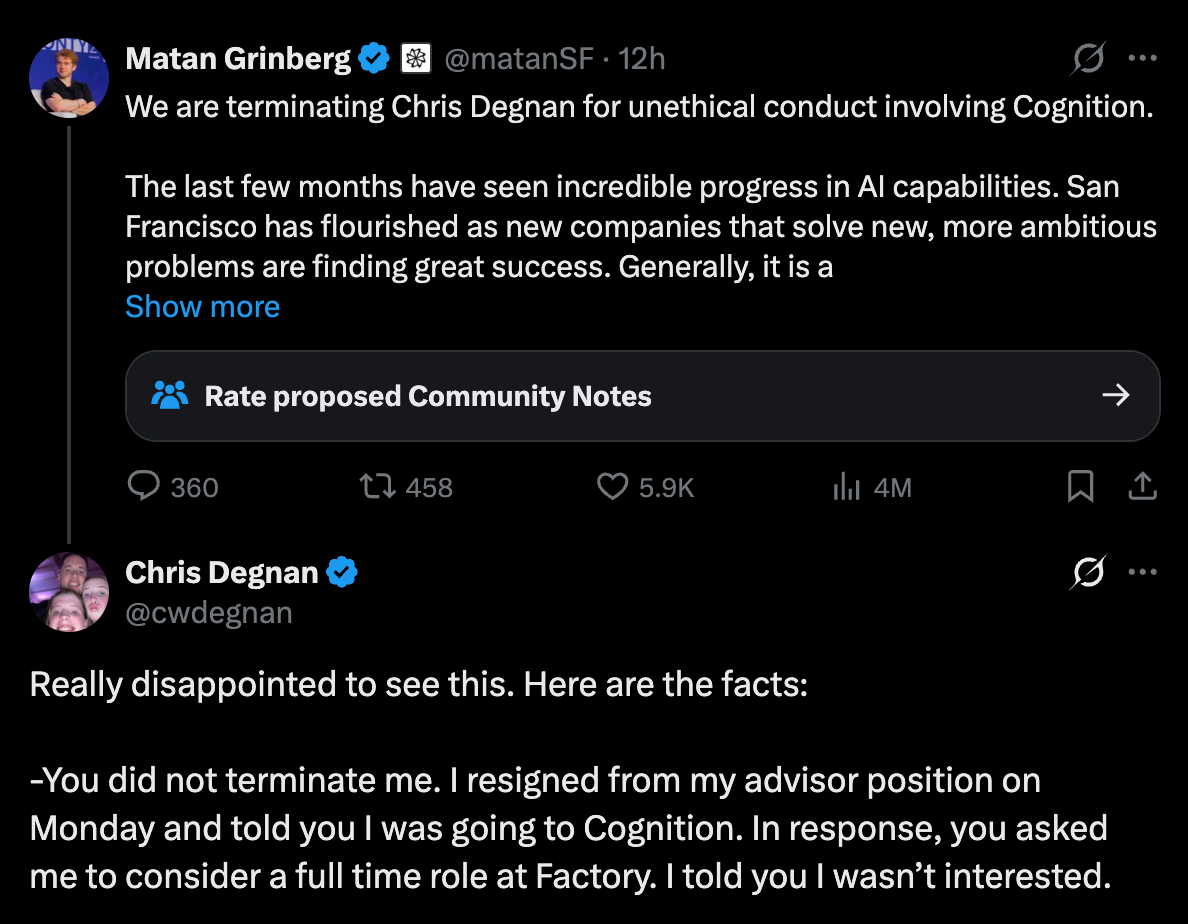
Factory CEO Matan Grinberg says former board adviser Chris Degnan discussed the company with Cognition while still advising Factory, then left to become Cognition’s chief revenue officer.
Degnan disputes the accusation, saying he resigned before taking the job and did not share confidential information with Cognition.
The conflict has also pulled investors into the dispute, highlighting growing tension as major VC firms increasingly hold stakes in direct AI competitors.
Why it matters: As AI markets become more competitive and investors back multiple rivals at once, board access and confidentiality are becoming much more sensitive governance issues.
ElevenLabs doubles its valuation to $22B

ElevenLabs completed a $300M employee tender offer at a $22B valuation, twice the $11B valuation it reached after raising $500M in February.
Wellington and T. Rowe Price co-led the transaction, allowing employees to sell part of their vested shares without the company going public.
It is ElevenLabs’ second employee liquidity program in a year, following a $100M tender at a $6.6B valuation in September 2025.
Why it matters: ElevenLabs’ rapid valuation growth shows voice AI is becoming one of the most valuable categories in generative AI, while employee tender offers are increasingly being used to retain talent at fast-growing private companies.
Google launches Gemini 4 Argon, its most powerful model yet

Google says Gemini 4 Argon can handle coding, research, writing, visual analysis, and complex long-running workflows, with especially strong performance in cybersecurity.
The model is being rolled out first to select security partners through Google’s Fairwind Program, where it can autonomously find, validate, and patch critical software vulnerabilities.
Google also claims Argon outperforms OpenAI’s GPT-6 Astra and Anthropic’s Fable and Opus models across several benchmarks.
Why it matters: Frontier AI competition is moving deeper into autonomous cyber work, where models are being asked not just to identify vulnerabilities but to validate and fix them with minimal human intervention.
OpenAI unveils Decisions API for faster, cheaper agent control

OpenAI introduced a limited-preview Decisions API that lets Luna choose between predefined options, making classification and agent decisions much faster than using a full frontier model.
The approach is similar to TypeSafe AI’s Jev, which developers are already using to reduce the cost and latency of software automation.
One promising use is agent monitoring: a Jev-based demo checked every agent action for just $2.94, versus $372 using a frontier LLM for the same type of oversight.
Why it matters: If lightweight decision models can reliably monitor every agent action, AI companies may be able to add continuous safety checks without the huge compute costs that make full-model supervision impractical.
Consumer AI is growing, but the economics still look ugly
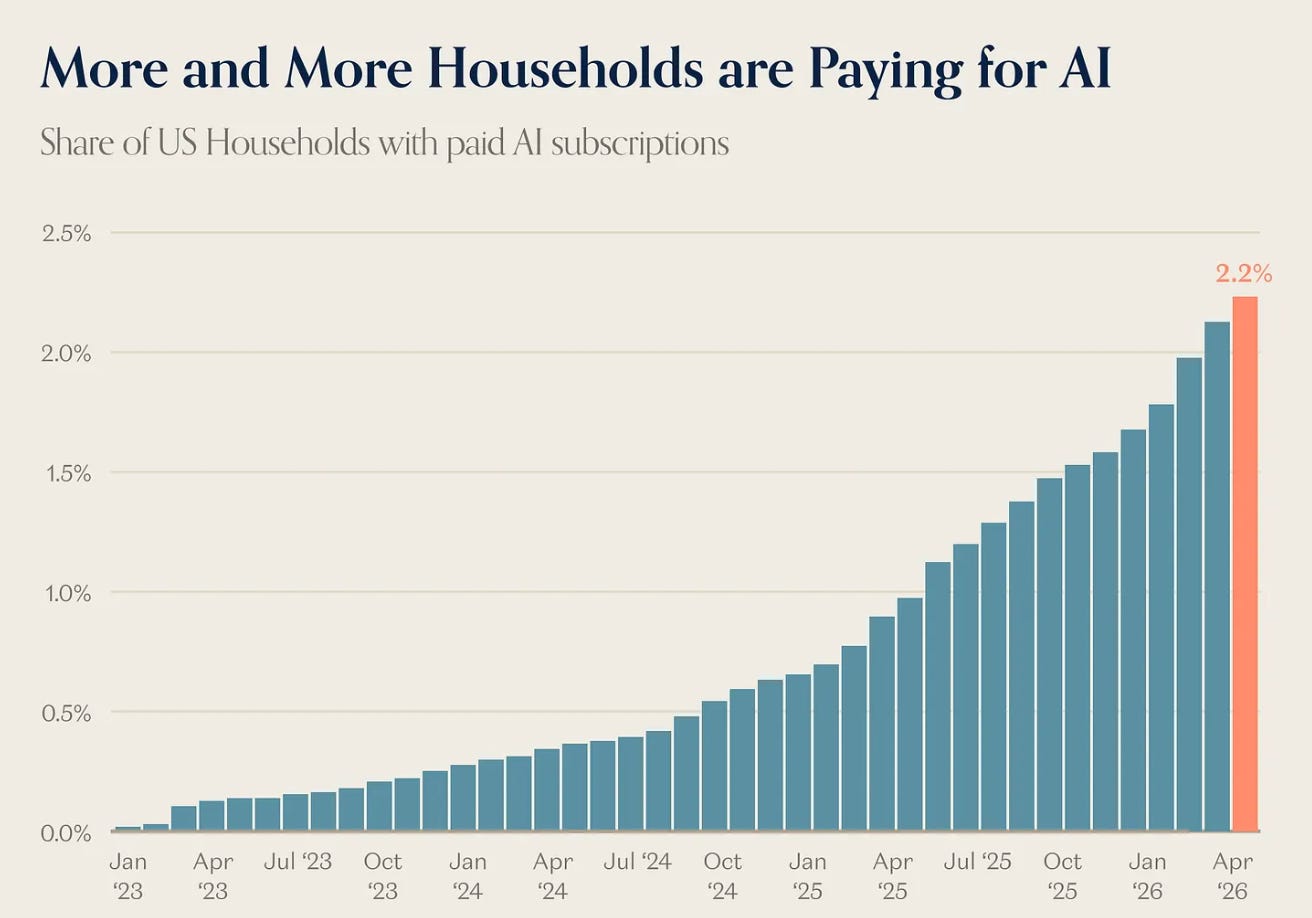
Consumer AI usage is rising, but paid adoption remains relatively low. PNC data showed just 2.2% of consumers paying for AI as of May, with average monthly spend around $31.
Even strong products like Muse, Dots, and Instinct face a basic problem: AI services are expensive to run, so large user bases do not automatically translate into profitable businesses.
That pressure is pushing companies toward enterprise revenue, with OpenAI expanding business sales, Meta moving Muse into enterprise use cases, and Instinct exploring transaction-based monetization.
Why it matters: The next phase of AI may be defined less by who wins the most users and more by who finds a business model that can support the underlying compute costs.
DeepSeek and Huawei team up on software for China’s AI chips
DeepSeek and Huawei are building open-source programming tools for Huawei’s Ascend chips, aiming to make homegrown hardware easier to use for advanced AI workloads.
The effort centers on TileLang, an open-source language that DeepSeek says is simpler than Nvidia’s CUDA while still extracting strong chip performance.
The companies also tuned software for a 128-chip Ascend 950 “supernode,” combining programming tools, compute libraries, and data-transfer infrastructure.
Why it matters: China’s challenge is not just building competitive AI chips. It also needs a strong software ecosystem around them, and this partnership is a direct attempt to reduce dependence on Nvidia’s CUDA stack.
Anthropic’s IPO filing reveals deep dependence on Amazon and Google
Anthropic routed 47% of its 2025 revenue through Amazon and Google’s cloud marketplaces, generating about $2.16B in sales through those channels.
The company paid roughly $351M in distribution fees, while also relying on the same partners for investment, compute capacity, customer access, and billing.
Customer concentration is another risk, with two unnamed customers each accounting for 12% of 2025 revenue, even as Anthropic carries more than $417B in long-term commitments.
Why it matters: Anthropic’s growth is tightly linked to the same Big Tech companies that are also its investors, suppliers, distributors, and competitors, making its business unusually dependent on a small group of powerful partners.
OpenAI launches Dots to compete in the autonomous AI agent race

OpenAI introduced Dots, always-on agents powered by GPT-6 Astra that can manage evolving projects, build software, prepare documents, and work across Slack and Microsoft Teams.
The company says Dots can operate autonomously but must ask for explicit permission before sensitive actions such as changing passwords or permanently deleting data.
OpenAI also said weekly users of Codex and ChatGPT Work have surpassed 35M, while ChatGPT has reached more than 1.2B weekly users.
Why it matters: OpenAI is turning autonomous agents into a core enterprise product, intensifying competition with Meta and others while putting safety, permissions, and data privacy at the center of the next phase of AI adoption.
LAST COFFEE SIP
🌎 Around The Ecosystem
AI agents + banking: Apollo chief economist Torsten Slok warns that autonomous agents could rapidly shift household deposits from low-interest accounts into higher-yield alternatives, creating a potential new form of synchronized “agentic bank run” as financial agents gain permission to move money.
MUST READ
📚 Worth Your Time
Which AI categories did investors fund and then abandon? Hot AI categories are turning faster, from funding wave to credibility crisis in months, not years. This piece maps where capital flowed from 2021 to 2026, which categories collapsed or got absorbed, and the signals founders should watch before their category gets written off.
How AI startups got their first customers: A practical analysis of how 50 emerging AI companies found their first paying customers. The piece shows why public launches rarely create revenue, and why founder networks, communities, proof-of-work emails, bake-offs, and demo clips worked better.
HIRING ALERT: STARTUPS & VC ROLES
💼 Today’s VC & Startup Job Opportunities
Senior Investment Associate - Remarkable Ventures | USA - Apply Here
Research Analyst - Kindred Venture | USA - Apply Here
Associate - CVS Health Ventures | USA - Apply Here
Associate, Early-Stage Investments - Premji Invest | USA - Apply Here
Investment Associate - Azolla Venture | USA - Apply Here
Investment Director(Strategic Investment) - YZi Lab | Remote - Apply Here
Portfolio Management Associate - Cerity Partner | USA - Apply Here
Investment Analyst - Peak XV Partner | Singapore - Apply Here
Associate - Venture Capital - Artha Group | India - Apply Here
Partner 36, Corporate Controller - a16z | USA - Apply Here
📍 Tips to Break Into VC
Every resource you need to break into VC, in one place
Breaking into venture capital usually means jumping between scattered posts, lectures, templates, spreadsheets, and interview guides.
This all-in-one hub brings together 100+ curated VC resources, including 14 structured learning modules, fellowship lectures, cap table and financial modeling templates, investment memo resources, scout guides, interview preparation, investor databases, and material on fund economics, valuation, market sizing, portfolio strategy, and more.
If you want one place to systematically learn venture capital and prepare for VC roles, this is a strong place to start.
PARTNERSHIP WITH US
🤝 Get your brand in front of 125,000+ decision makers.
Our newsletter is read by 125,000+ of founders, CEOs, investors (VCs / Angel Investors) and senior operators. Get in touch today.
Do you have any news to share about your Startup or VC fund? Please email us.
We’ll be back in your inbox on Tomorrow.